
Perkenalan
Renolith promotional material claims “Triple the life at half the cost”, implying a six-fold improvement in the value-for-money of road assets. This article explains the basis for this bold claim via a worked example.
Principles
The cost reduction and life enhancement claims are underpinned by two key principles:
- Cementitious stabilisation is a low-cost construction/rehabilitation method, but introduces challenges with fatigue cracking and shrinkage cracking.
- Renolith admixture mitigates the cracking risks, enabling a high modulus cemented base layer with no need for overlay.
Scenario
The scenario is the renewal of a road that is in very poor structural condition, with ruts, cracks, and potholes. The road pavement is assumed to consist of a 250mm base (including subbase) layer of degraded local granular material with a non-structural spray seal. The subgrade CBR is 4%. This scenario mirrors the New England Hwy Trial.
The two rehabilitation options under consideration are:
- Restore
- Reinstate the original design by replacing the failed base with new granular material
- Upcycle
- Upcycle the failed base to a nanoengineered material via stabilisation with cementitious binder and Renolith 2.0 admixture
- Restore
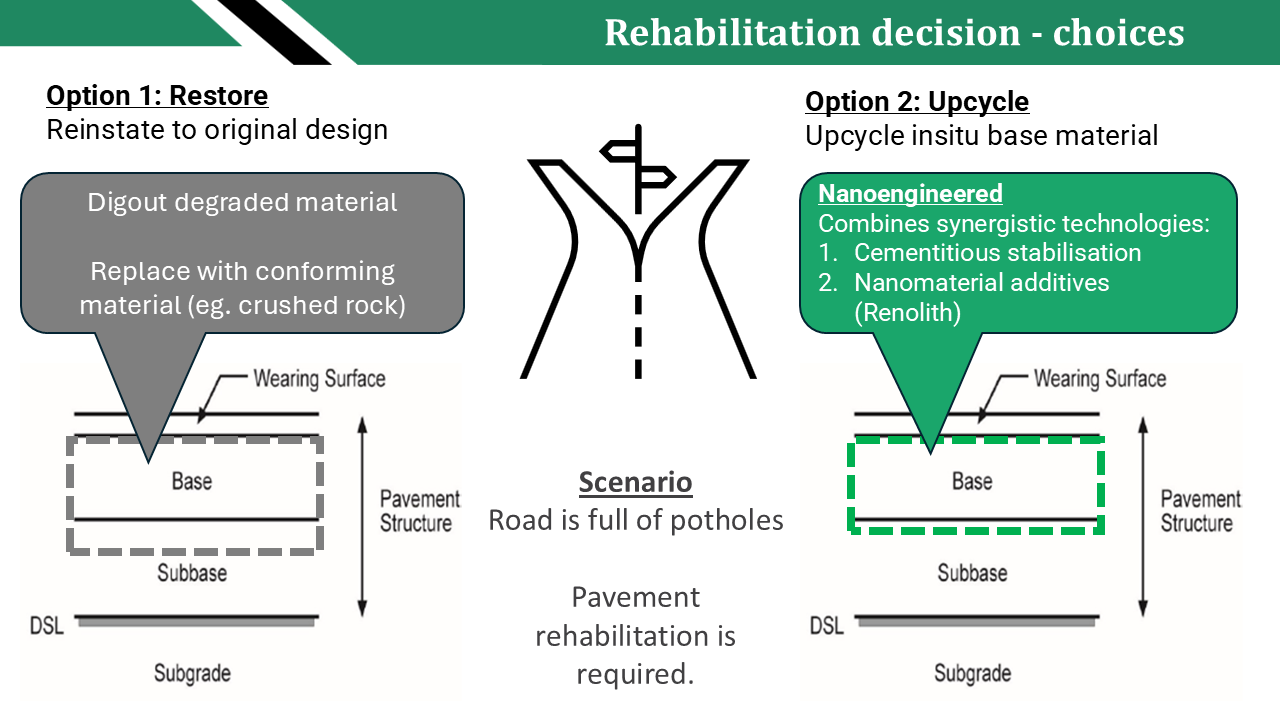
Figure 1: Road renewal decision – Restore vs Upcycle
Opsi desain dinilai berdasarkan asumsi dan penyederhanaan berikut:
- Non-structural spray seals will be reinstated
- Surface levels do not change (e.g. align with extant kerb & channel if relevant).
- The base will be remediated to full depth of 250mm
- The subgrade will not be remediated.
- The design loading adopts a Standard Axle Design and the ratio of Equivalent Standard Axles (ESA) to Heavy Vehicle Axle Groups (HVAG) = 0.7.
- Design life (measured in years) correlates with pavement fatigue life, measured in ESA
- Cost and embodied greenhouse gas (GHG) emissions for each option are modelled using the Estimator Triple Bottom Line using data derived from White and Young (2025): Objective Comparison of the Economic and Environmental Costs of Different Rehabilitation Designs for Flexible Local Road Pavements
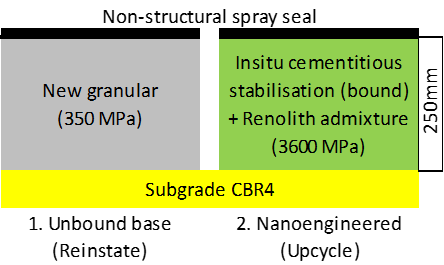
Figure 2: Road pavement structure – Unbound granular base vs nanoengineered base
Option 1: Restore
Option 1 reinstates the original design by replacing the failed 250mm base with new granular material. The cost will vary according to various project specific factors, such as disposal costs and quarry proximity. A typical cost for such a pavement is AUD $80-$100 per m2.
The new granular material is assumed to be ‘normal standard crushed rock’, with presumptive values per Austroads AGPT02 section 6.2.3. The maximum vertical modulus is 350MPa per Austroads AGPT02 table 6.3.
Perangkat Lunak Analisis dan Desain Perkerasan Austroads AustPADS allows users to conduct advanced mechanistic analysis of the response-to-load of road pavements. The AustPADS sublayering function was used for calculating the moduli of sublayers.
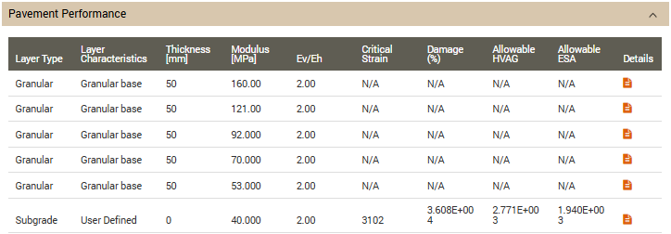
Figure 3: AustPads output – 250mm unbound granular base on CBR4 subgrade
For option 1 (Restore), the pavement life calculated by AustPADS is 1.94e3 ESA. This is very low and not practical, even for a lightly trafficked road.
Option 1b: Double thickness
To improve the fatigue life, option 1b doubles the unbound granular base layer thickness from 250mm to 500mm.
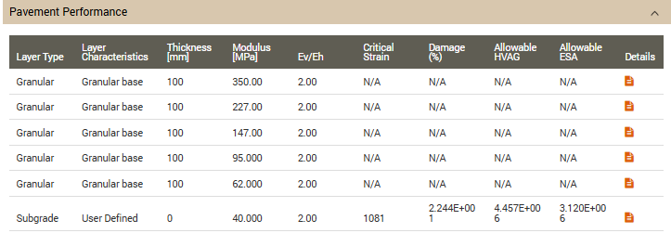
Figure 4: 500mm unbound granular base on CBR4 subgrade
For option 1b (Double thickness), the pavement life calculated by AustPADS is 3.12e6 ESA. This is a more practical value for a local road with medium traffic.
Option 2: Upcycle
Option 2 upcycles the failed 250mm insitu base material to a nanoengineered-bound material via stabilisation with ~3-4% cementitious binder and ‘Renolith 2.0’ admixture. A typical cost for such a pavement is no more than AUD $40 per m2, assuming locally available plant or a sufficiently large project to justify plant mobilisation.
The nanoengineered layer is institu granular material stabilised with cementitious binder and Renolith 2.0 admixture.
‘'Renolith 2.0' adalah campuran nanomaterial dan polimer dalam air. Dalam konteks desain ini, diasumsikan dapat meningkatkan material yang disemen sebagai berikut:
- Renolith mencegah retak akibat penyusutan makro., Oleh karena itu, tidak diperlukan lapisan granular untuk menutupi retakan reflektif. Lapisan permukaan berupa lapisan penyegel semprot diaplikasikan langsung di atas lapisan dasar yang terikat.
- Renolith mengurangi permeabilitas dan meningkatkan kekuatan basah, oleh karena itu lapisan dasarnya sangat ulet terhadap kerusakan yang berhubungan dengan air. Jadi, lubang di jalan sangat kecil kemungkinannya terjadi meskipun perawatan lapisan pelindung jalan diabaikan atau jalan tersebut terkena banjir.
- Renolith meningkatkan kekuatan dan modulus. Austroads AGPT02 table 6.7 suggests a modulus in the range 3000MPa to 6000MPa for heavily bound subbase quality cemented materials. Assuming a 3000MPa cemented material, with modulus enhanced by 20% by the Renolith admixture, yields a nanoengineered material with modulus of 3600MPa.

Figure 5: 250mm Cemented (nanoengineered) base on CBR4 subgrade
Perbandingan
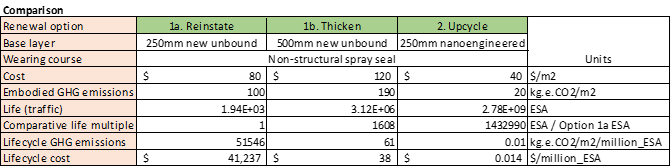
The nanoengineered upcycled road is half the initial cost of the reinstated unbound granular option. The calculated fatigue life of the reinstated 250mm unbound base is only 1940 ESA. Doubling the thickness to 500mm improves the life by 3 orders of magnitude, but at increased cost and embodied GHG emissions. The calculated fatigue life of the Renolith nanoengineered road is 2,780,000,000 ESA; orders of magnitude greater than both of the unbound pavements. Accordingly, the lifecycle cost and lifecycle GHG emissions of the Renolith nanoengineered road are substantially lower.
Table 1: Life, cost and emissions comparison
The nanoengineered upcycled road also has substantial resilience and sustainability advantages.
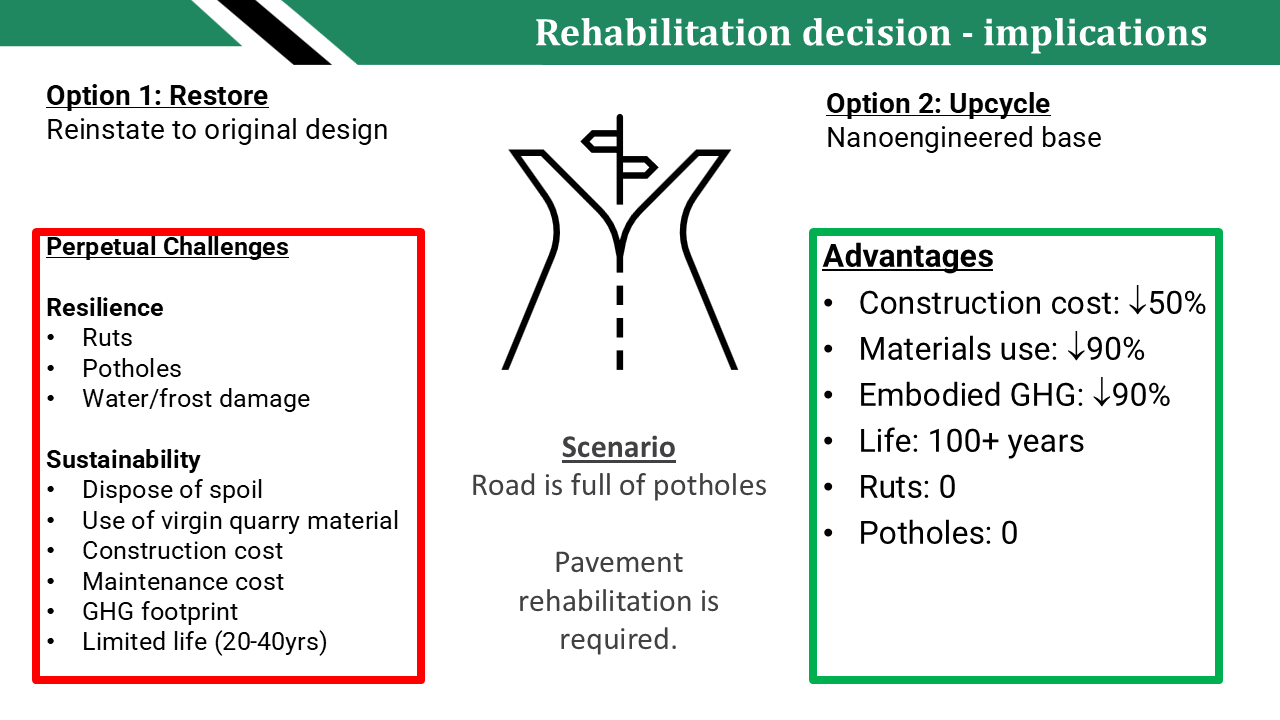
Figure 6: Road renewal decision – Restore vs Upcycle – Implications
Kesimpulan
Conventional unbound granular road pavements are expensive and have a short life. Renolith upcycled nanoengineered roads are typically less than half the initial cost and yield an enormous life increase. ‘Triple the life’ is an understatement. Lifecycle costs are dramatically reduced. Factoring in the substantial sustainability and resilience advantages, such as the elimination of potholes and low embodied GHG emissions, it is clear that upcycling via Renolith-enhanced cementitious stabilisation is the superior option.
-
Renolith Roads - Triple the Life at Half the Cost
-
Merehabilitasi Jalan-jalan di Victoria
-
Cara memperbaiki lubang di jalanan Victoria
-
Cara Mencegah, Memperbaiki, dan Menghentikan Lubang di Jalan Menggunakan Stabilisasi Semen Modern
-
Infrastruktur Jalan Berkelanjutan: Menggunakan Bahan Daur Ulang dalam Konstruksi Jalan