
- Home
- »
- News Articles
- »
- Resilient, Sustainable, Nanoengineered Road Upgrades…
Executive Summary
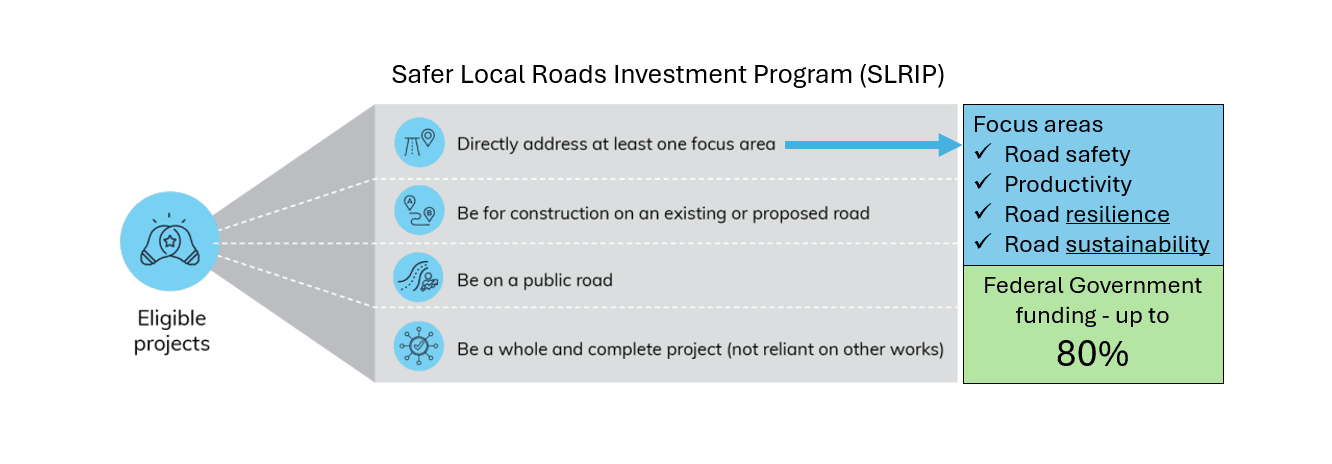
The Safer Local Roads and Infrastructure Program (SLRIP) commenced from 1 July 2024 to provide funding for projects to address current and emerging priorities in road infrastructure needs. Funding of at least $200 million per year will be available under the program. The Program is an application-based merit-assessed funding program. For projects submitted by LGAs, the Program will contribute up to 80% of the total project cost for projects located in regional and remote areas, up to the cap of $5 million per project.
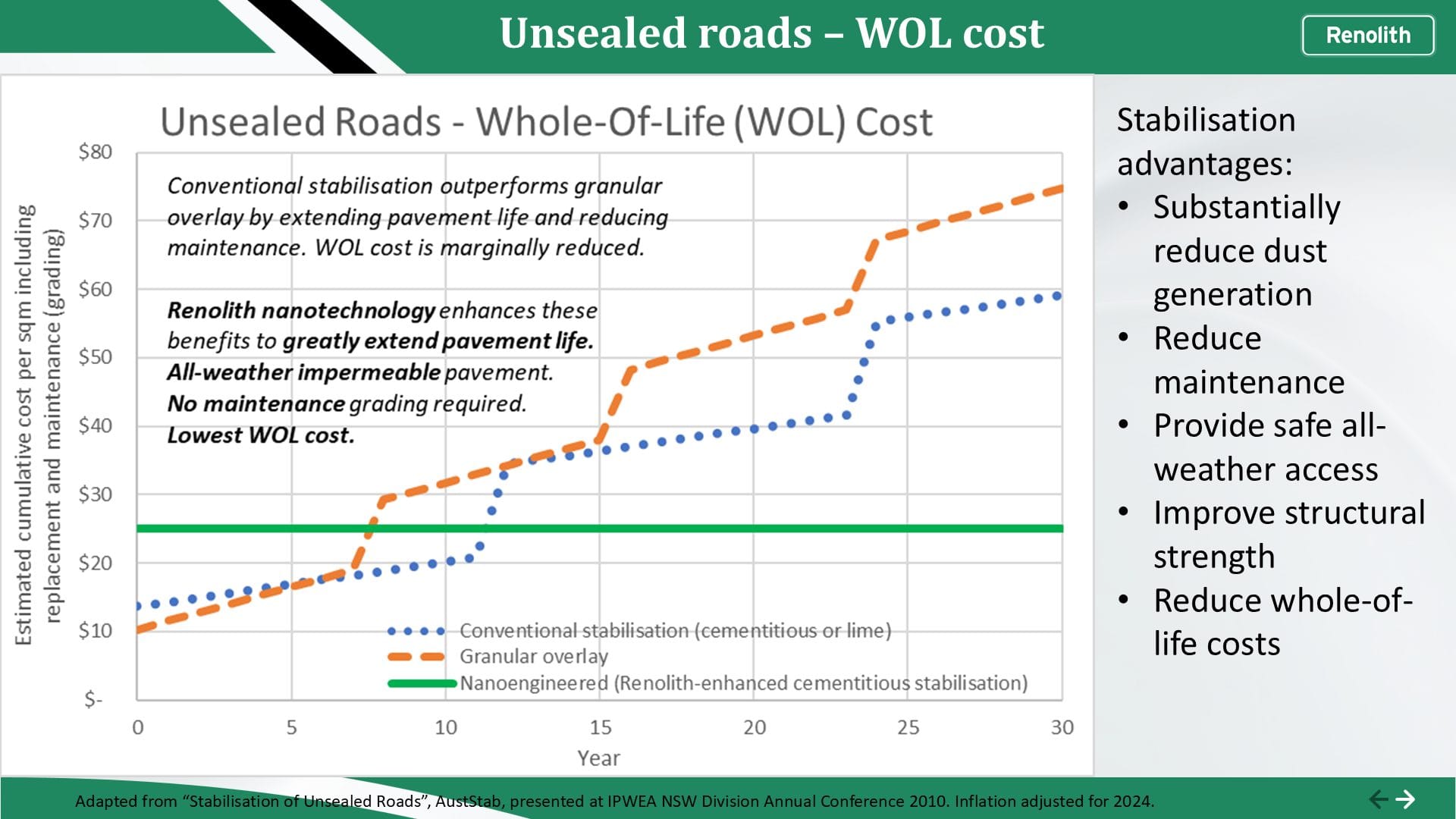
Typically, such a pavement costs $25-$35 per sqm +GST to construct. Up to 80% of the cost could be covered by SLRIP funding; so a Council’s contribution would be 20% ($5-$7 per sqm). In this scenario, your Council could upgrade any unsealed road to an impermeable, resilient, sustainable, nanoengineered pavement asset for less than the cost of a gravel re-sheet. The whole-of-life cost is radically reduced.
The Challenge
Local roads make up 75% of Australia’s road network, but local government raises only 3.6% of tax revenues. Road maintenance has been chronically underfunded, particularly in Regional & Remote Councils. The accelerated asset degradation from extreme weather events coupled with increased freight & traffic makes it challenging to meet community expectations regarding road quality, safety and sustainability.
The Opportunity
Recent changes to federal road funding arrangements and Renolith’s world-leading nanotechnology provide an excellent opportunity for a Council to invest in upgrading road pavement assets.
Funding – SLRIP
The Safer Local Roads and Infrastructure Program (SLRIP) commenced from 1 July 2024 to provide funding for projects to address current and emerging priorities in road infrastructure needs. Funding of at least $200 million per year will be available under the program. The Program has been created as part of the Australian Government’s commitment to strengthen investment to support the delivery of safer and more productive roads across Australia.
The Program is an application-based merit-assessed funding program. For projects submitted by LGAs, the Program will contribute up to 80% of the total project cost for projects located in regional and remote areas, up to the cap of $5 million per project.
Applications must directly address at least one of the Program’s focus areas which are linked to priorities in road infrastructure needs. The six focus areas are road safety, productivity, bridge renewal, road resilience, road sustainability and heavy vehicle rest area.
Renolith Nanotechnology
Renolith 2.0™ nanotechnology is an admixture for cementitious binders. Its super-pozzolanic behaviour significantly improves the engineering properties of cementitiously bound materials. It prevents shrinkage cracking problems, so pavements may be heavily bound. Renolith enhanced pavements are tough, impermeable, self-healing and highly resistant to damage from water and traffic. The technology has been proven in a wide variety of soils and aggregates in hundreds of projects from dirt roads to freeways, totalling more than 70,000,000m2 of resilient, sustainable, low-cost, low-carbon, pothole-free, upcycled roads.
Renolith nanotechnology is perfectly aligned with the SLRIP focus areas of road resilience and road sustainability.
Project selection
Project selection depends on Council’s priorities and the SLRIP rules. The SLRIP guidelines provide examples of potentially eligible projects, such as:
- widening and sealing roads to accommodate heavy vehicle access
- construction of new or upgraded heavy vehicle rest areas
- upgrading of roads to improve flood immunity
- upgrading of roads to allow for efficient emergency response times and evacuation
- additional road linkages between communities to reduce risk of isolation during an emergency
- construction projects that use low or zero emission building materials, including low or zero emission building materials which used recycled materials or contribute to circular economy outcomes
- sealing a road to reduce isolation of remote communities during the wet reason.
Example project – upgrade unsealed road
A typical design suited to regional and remote LGAs was proven in the Queensland Department of Main Roads (now TMR) trial of the Renolith product. The selected trial road was subject to inundation and suffered from severe rutting, corrugations and local failures. The trial project sought to test the effectiveness of refurbishing and upgrading soil pavement roads via stabilisation with Renolith and cement.
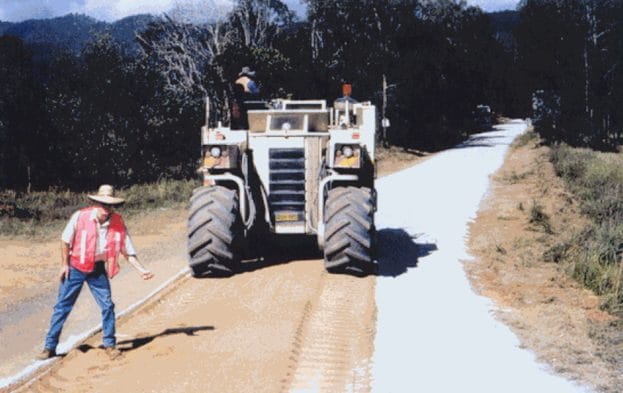
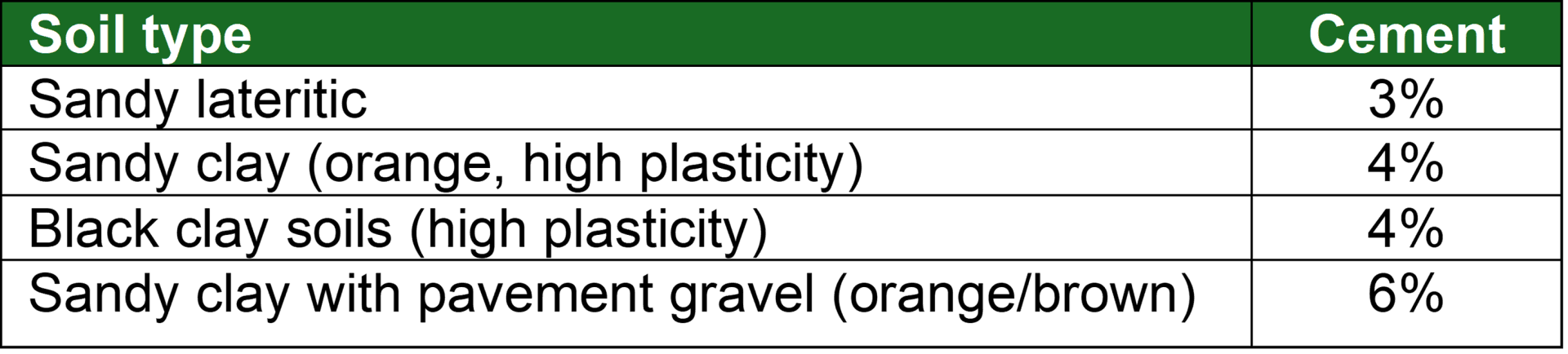
The pavement consisted of four sections of different materials. Each section was stabilised with cement and Renolith admixture.
The trial report concluded:
The sandy soils when stabilised with cement and Renolith produced a very hard running surface that did not furrow nor pothole after the 28-day trial period. This outcome is completely different to the pavement performance prior to the trial.
The orange sandy clay soils have produced an extremely hard, and dense pavement with a glassy wearing surface following trimming. No deterioration of the pavement, surface crazing or cracking is evident, such as exists on similar road surfaces which have not been stabilized.
The sandy clay soil/gravel pavement section west of the bridge has performed extremely well. There are no signs of pavement fatigue, shrinkage cracking, rutting or potholing which is evident in the adjacent untreated section of pavement.
The Renolith product when mixed with cement and stabilised appears to be a most efficient and cost-effective product for the upgrading of soil pavement roads, and especially those where a continuous construction output can be achieved. The rate of construction is dependent on only the availability of materials at the site, e.g., cement, Renolith and water, and the capabilities of the plant and expertise of the operators of that plant assigned to undertake the roadworks required.
Typically, such a pavement costs $25-$35 per sqm +GST to construct. Up to 80% of the cost could be covered by SLRIP funding; so Council’s contribution would be 20% ($5-$7 per sqm). In this scenario, a Council could upgrade any unsealed road to an impermeable, resilient, sustainable, nanoengineered pavement asset for less than the cost of a gravel re-sheet. The whole-of-life cost is radically reduced.
Next steps
SLRIP applications are assessed by Government 3 times per year. We can assist a Council with the application process, but we need time to assess the project opportunity and prepare documentation.
Conclusion
The Safer Local Roads and Infrastructure Program (SLRIP) commenced from 1 July 2024 to provide funding for projects to address current and emerging priorities in road infrastructure needs. Funding of at least $200 million per year will be available under the program. The Program has been created as part of the Australian Government’s commitment to strengthen investment to support the delivery of safer and more productive roads across Australia.
The Program is an application-based merit-assessed funding program. For projects submitted by LGAs, the Program will contribute up to 80% of the total project cost for projects located in regional and remote areas, up to the cap of $5 million per project.
Applications must directly address at least one of the Program’s focus areas which are linked to priorities in road infrastructure needs. The six focus areas are road safety, productivity, bridge renewal, road resilience, road sustainability and heavy vehicle rest area.
Renolith nanotechnology is perfectly aligned with the SLRIP focus areas of road resilience and road sustainability.
Typically, such a pavement costs $25-$35 per sqm +GST to construct. Up to 80% of the cost could be covered by SLRIP funding; so Council’s contribution would be 20% ($5-$7 per sqm). In this scenario, a Council could upgrade any unsealed road to an impermeable, resilient, sustainable, nanoengineered pavement asset for less than the cost of a gravel re-sheet. The whole-of-life cost is radically reduced.