
Executive Summary
Potholes are a design choice. Conventional road bases are formed from compacted granular material such as crushed rock. When water gets in, such roads are susceptible to potholes. Renolith nanoengineered roads are not.
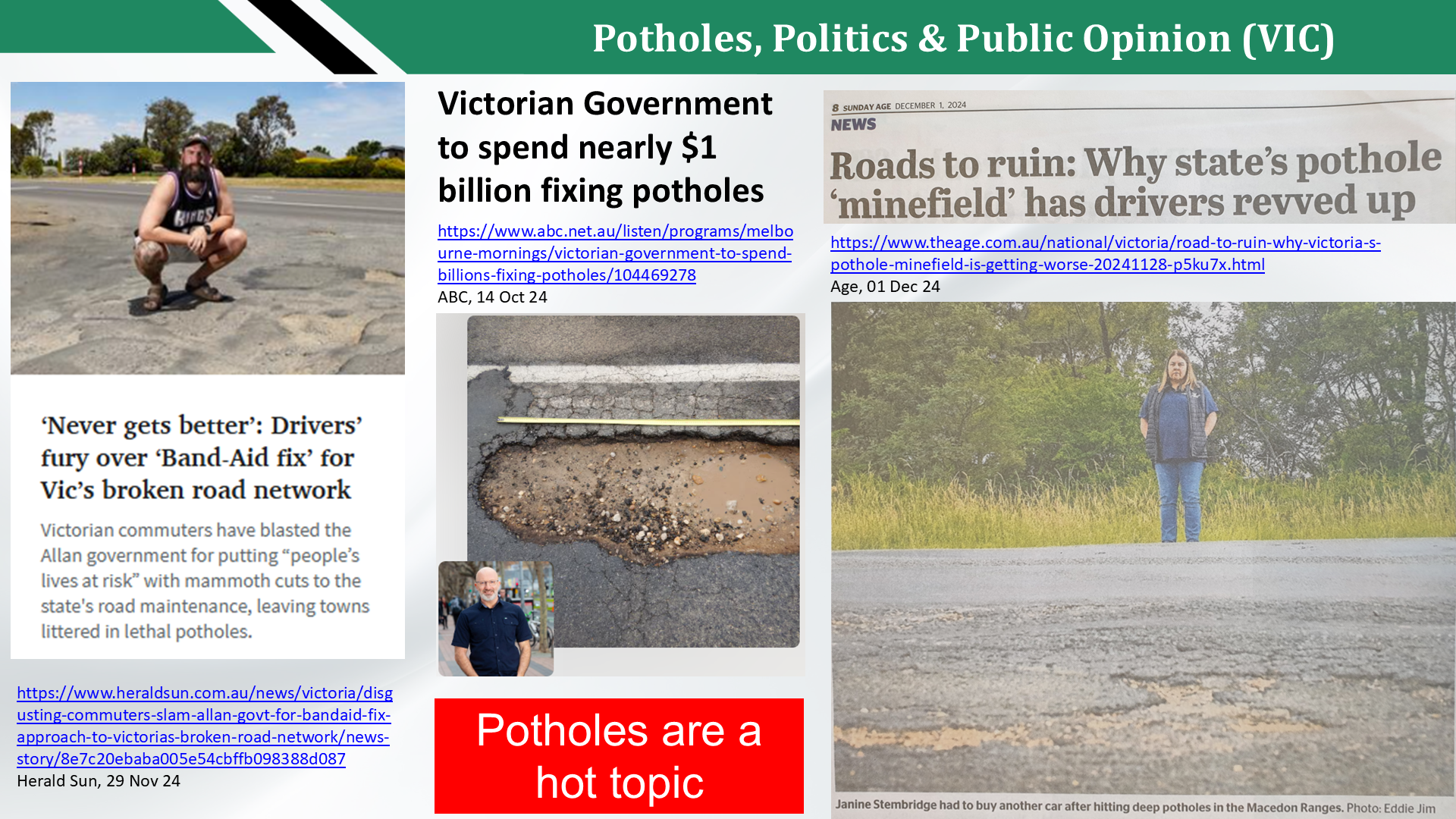
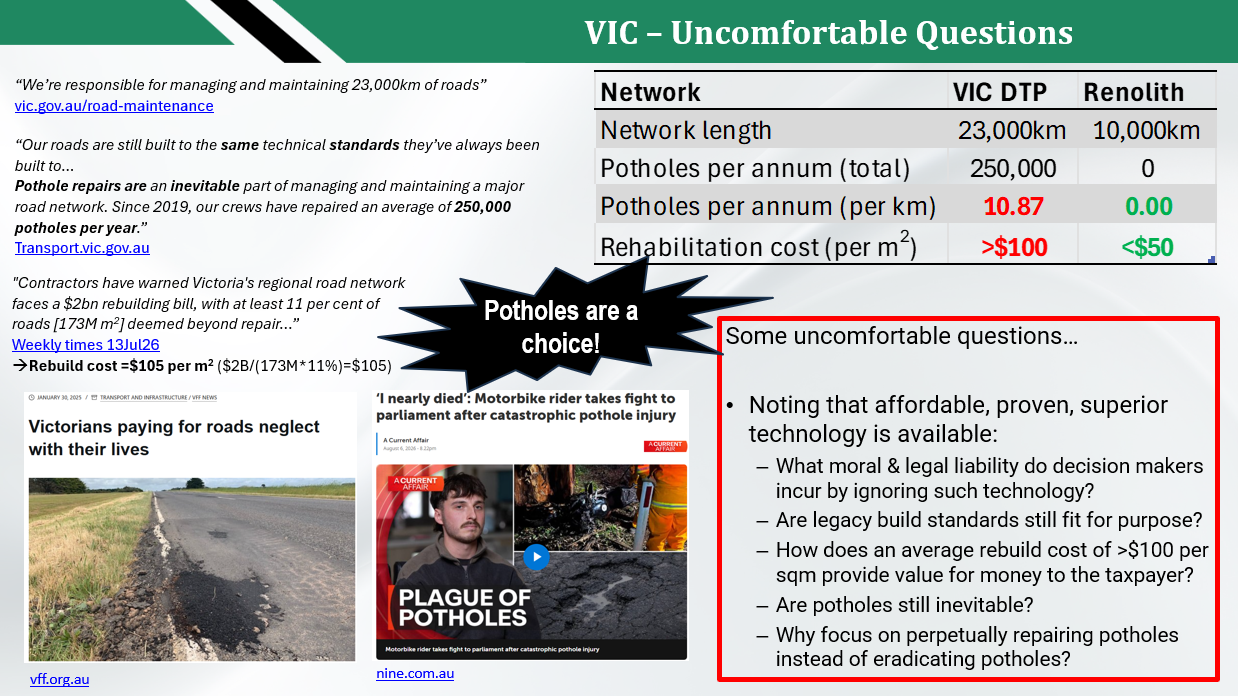
Victoria’s state-managed 23,000km road network generates 250,000 potholes per year. The 10,000km global road network built with Renolith nanotechnology generates none.
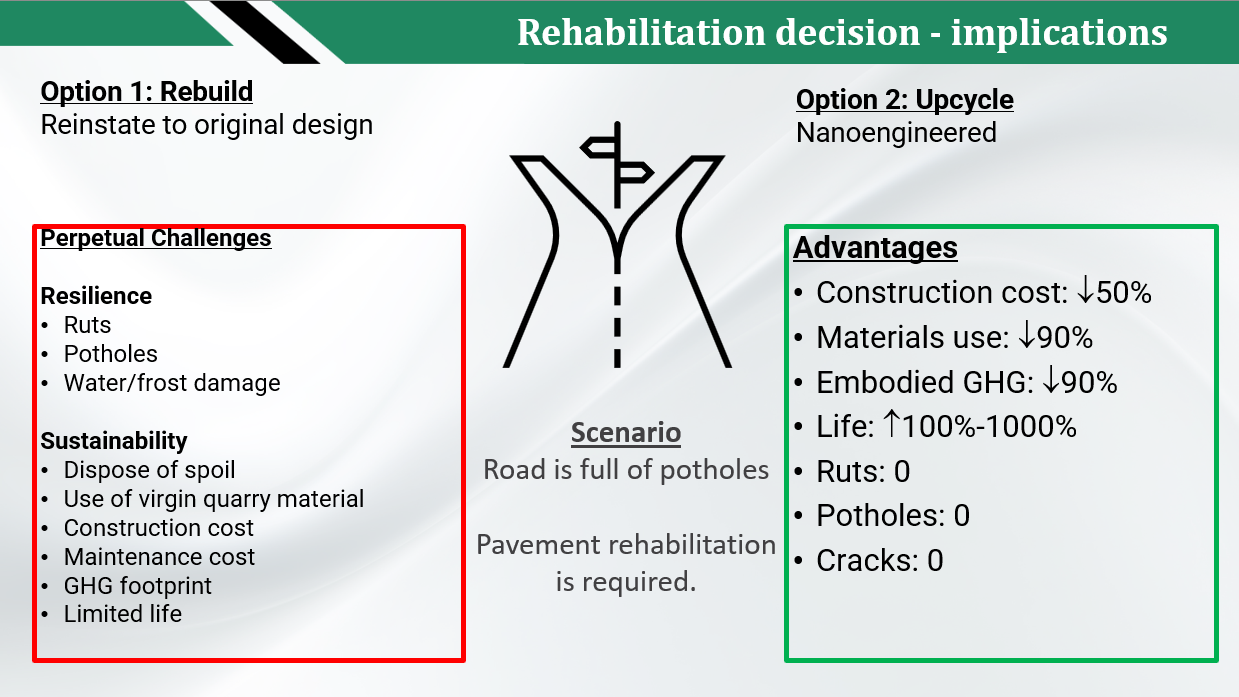
Consider a typical scenario: the road is beyond repair – full rehabilitation is required. Rather than replace the failed road base with new material and perpetuate the problems, why not upcycle it to a nanoengineered material? This can yield multiple benefits:
• Reconstruction cost: reduced by >50%
• Embodied GHG emissions: reduced by >90%
• Life (traffic capacity): increased by >100%
• Insitu materials recycled: 100%
• Cracks: 0
• Ruts: 0
• Potholes: 0
If potholes are the disease, Renolith is the cure.
Challenges
So what is the solution?
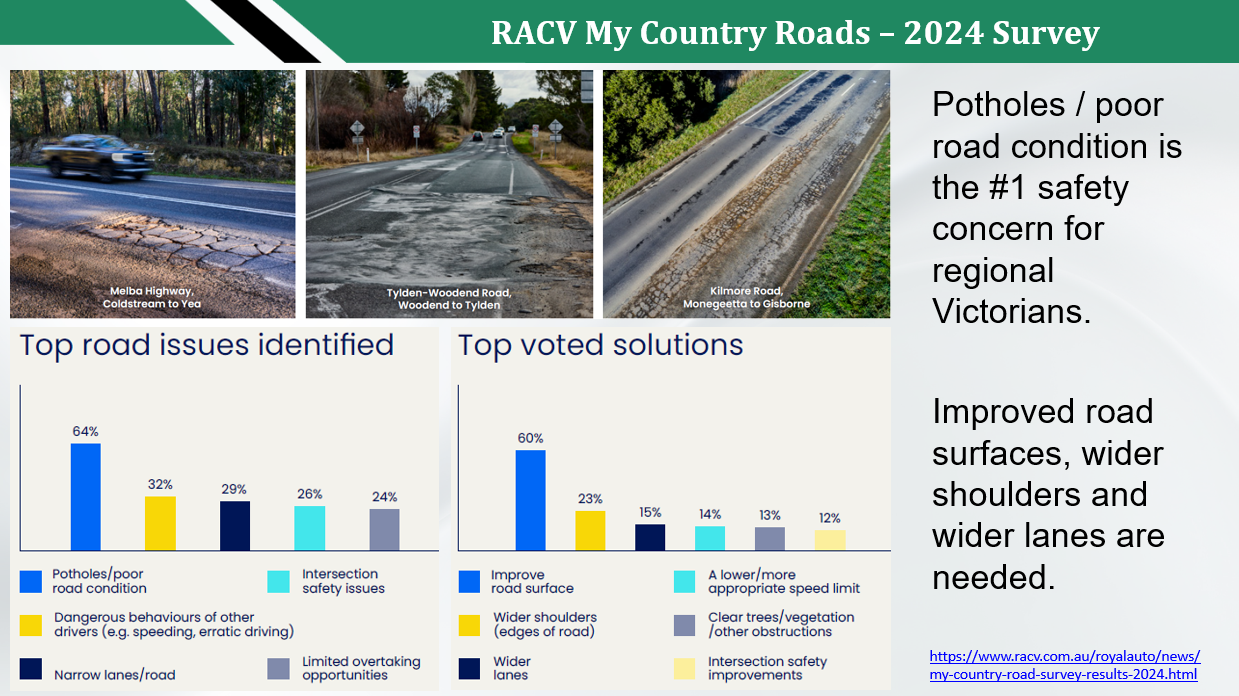
Any post about potholes on social media will generate hundreds of strident but often uninformed opinions on the matter. More credible sources include The Grattan Institute and the Australian Flexible Pavement Association (AfPA). The Grattan Institute advocates to increase road maintenance funding and improve the funding allocation model (link). AfPA advocates to do more resealing (link).
These seem like sensible ideas. Lets test how effective they are likely to be.
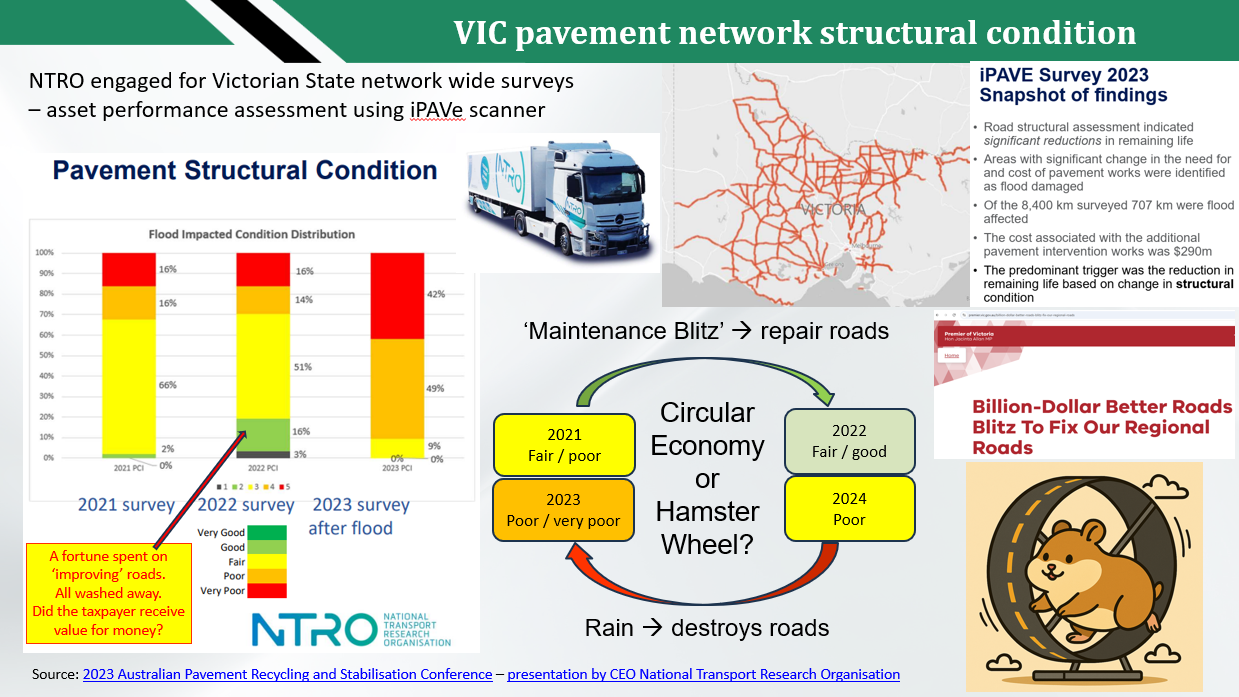
From 2021-2023, the National Transport Research Organisation (NTRO) performed an annual structural assessment on 8400km of the Victorian state network. Of the 8400km surveyed, 707km were affected by the 2022 floods. In 2021, only 2% of this 707km subset was in good structural condition. Hundreds of millions of dollars were spent in rehabilitation and resealing. When the 2022 survey was conducted, 19% was in good or very good condition. Then, in October 2022, the rains came. By 2023, none of the flood affected roads were in good condition. More than 90% were in poor or very poor condition.
Rather than answering the pothole problem, this leaves us with some uncomfortable questions:
- If resealing is so effective, how is it possible for hundreds of kilometres of newly sealed roads to degrade so quickly?
- Did the community receive value for money from these rehabilitation and resealing works?
- The Victorian government already spends $1 Billion per annum on road maintenance. Local government also spends a fortune. Is more is needed? How much? Nobody seems to know.
- What happens if it rains again?
Resilience
The fundamental problem is that Victoria’s roads are fragile. They lack resilience. Victorian regional roads typically consist of a spray sealed (bitumen) wearing course over an unbound granular base of crushed rock or gravel. Water is kryptonite to unbound granular road bases. As articulated in Austroads report AP-R744-25 Climate Change and Natural Hazards – Resilience Needs and Guidance Approaches:
Australia is a predominantly dry, arid country which lends itself to the use of thin unbound granular pavements over vast distances. However, this leaves the network exposed to rapid deterioration when wet weather is experienced. … Austroads has identified the critical need to enhance the resilience of the land transport system to climate change and natural hazards (CCNH). The increasing frequency and severity of extreme weather events, alongside long-term climatic changes, pose significant risks to transport infrastructure. These challenges disrupt the movement of people and goods, impact economic activities, and threaten community safety.
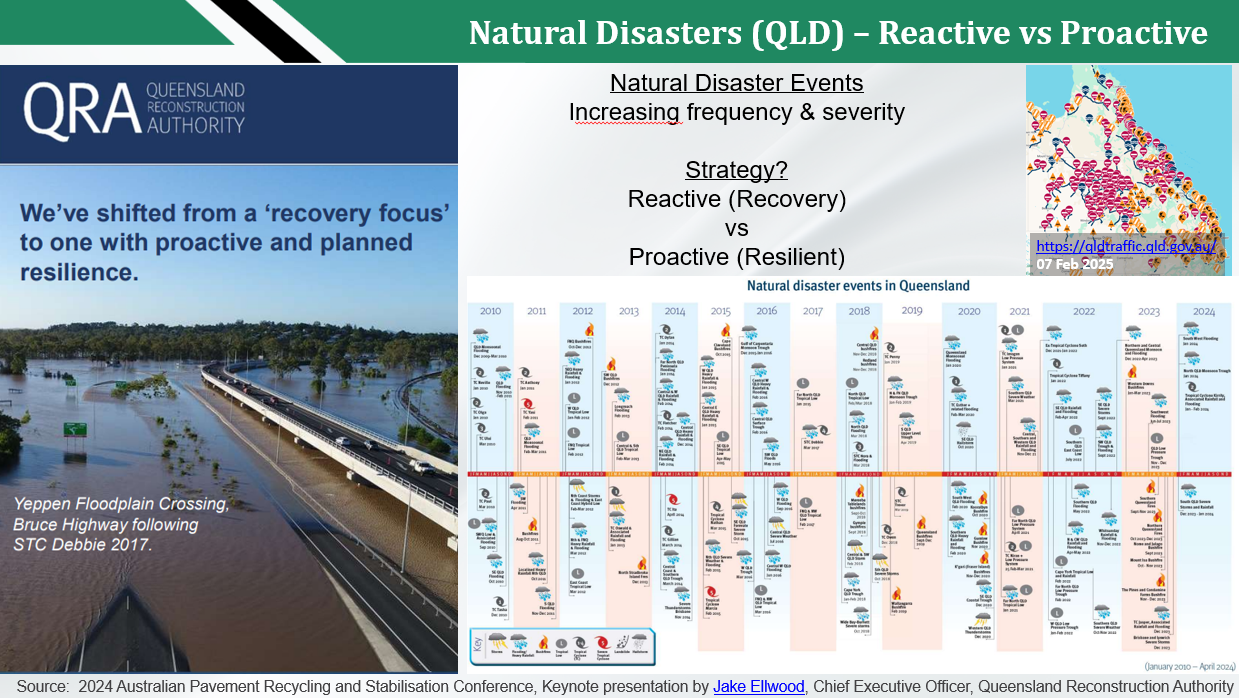
This problem is not unique to Victoria, but Victoria has been slow to respond. In contrast, in response to a constant barrage of natural disaster events, the Queensland Reconstruction Authority (QRA) has shifted from a ‘recovery focus’ to one with proactive and planned resilience.
Essential elements of the solution were articulated by Engineers Australia in their 2023 submission to government: Engineering a resilient and sustainable rural, regional and remote road network, which recommended:
…include more climate resilient and recycled materials.
…greater uptake of materials which have waterproofing benefits.
…embed sustainability, resilience and circular economy principles at all stages of the asset lifecycle.
In simple terms, resilient roads do not form potholes.
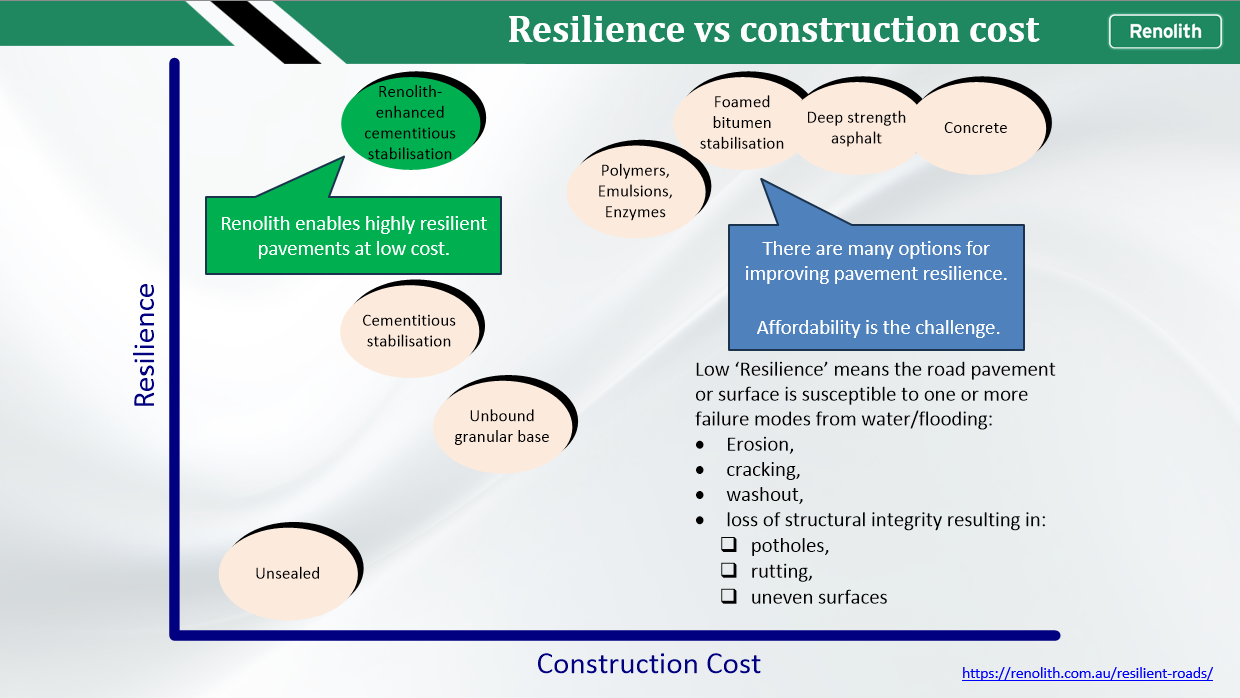
One method to improve resilience is Foamed bitumen stabilisation (FBS). Infrastructure Victoria investigated FBS in Adapting Victoria’s infrastructure to climate change – Phase 3: Economic analysis of adaptation for roads. They concluded that FBS increased construction cost but produced a positive return on investment.
There are various other technical approaches to achieve a resilient road pavement. However, the theme is similar – resilience is expensive: the construction cost and embodied GHG emissions footprint are high. The exception is nanoengineered roads. Nanoengineered road bases actually cost less to construct than unbound granular bases. Renolith nanotechnology offers a low-cost, low-emissions pathway to eliminating potholes.
Choices
According to Transport.vic.gov.au
“Our roads are still built to the same technical standards they’ve always been built to…
Pothole repairs are an inevitable part of managing and maintaining a major road network. Since 2019, our crews have repaired an average of 250,000 potholes per year.”
According to the Weekly times (13Jul26):
“Contractors have warned Victoria’s regional road network faces a $2bn rebuilding bill, with at least 11 per cent of roads [173M m2] deemed beyond repair…”
So, when a road needs rehabilitation, the choice for Victoria is: rebuild to the original design, or try something different?
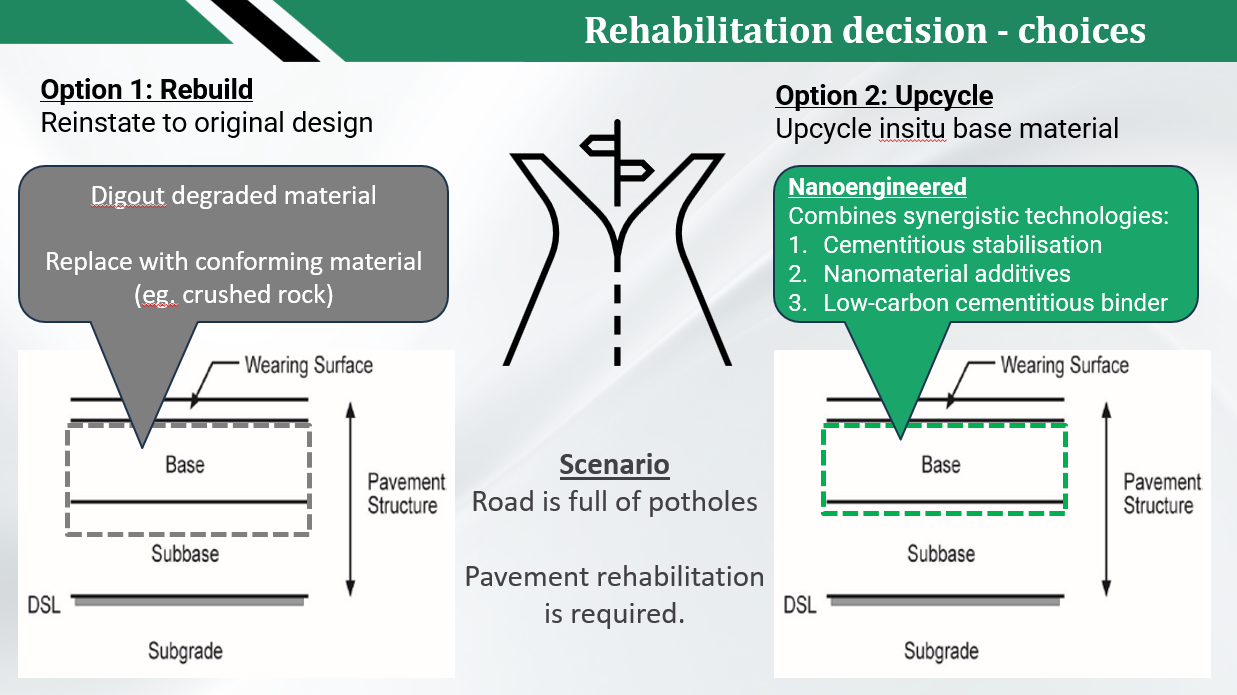
The lazy engineer will reinstate the original design. This is easy. It is also expensive, unsustainable and will perpetuate the risk of potholes.
The visionary engineer will improve the design. With Renolith nanotechnology it is possible to simultaneously upcycle 100% of the failed base material, eliminate potholes and radically reduce the whole-of-life cost of the road.
Ultimately, potholes are a design choice. Renolith nanotechnology has been available in Victoria since 2022. It is compatible with the relevant specifications such as VIC Department of Transport and Planning – Standard – Section 307 – Insitu Stabilisation of Pavements with Cementitious Binders, 2023 and Austroads ATS-3330. It has been tested and validated by RMIT University. However, as of August 2026, this technology is yet to be adopted in a single Victorian project or maintenance activity. This raises some uncomfortable questions for decision makers:
-
- What moral & legal liability do decision makers incur by ignoring such technology?
- Are legacy build standards still fit for purpose?
- How does an average rebuild cost of >$100 per sqm provide value for money to the taxpayer?
- Are potholes still inevitable?
- Why focus on perpetually repairing potholes instead of eradicating potholes?
Conclusion
Potholes are not inevitable. Potholes are a choice. Resilient roads do not form potholes. To date, Victoria has chosen to perpetuate road pavement designs that lack resilience. Resilience can be greatly improved by upcycling the base layer into a nanoengineered material. Renolith nanotechnology offers a simple, affordable and proven method to form nanoengineered roads. Road rehabilitation costs can be cut in half. Billions of dollars can be saved. Potholes can be eliminated.