
Executive Summary
Victoria’s state roads are deteriorating. Roughly 37% of the state’s 23,000km road network is in very poor condition and will imminently require rehabilitation. Selection of effective and affordable rehabilitation treatments will be critical to reverse the decline of the network.
This article models three simplified pavement rehabilitation design archetypes and assesses their suitability for Victorian regional roads.
The first option modelled involves reinstating an unbound granular base. This is the least cost-effective alternative and will perpetuate susceptibility to potholes.
The second option involves insitu cementitious stabilisation of the degraded pavement and applying a granular overlay. This approach improves theoretical life (traffic capacity) of the road but increases susceptibility to potholes.
The third design modelled involves insitu stabilisation of the degraded pavement with cementitious binder and Renolith 2.0 admixture. This alternative offers the lowest cost and materials footprint. It also achieves the longest life and virtually eliminates the risk of potholes. This rehabilitation model has excellent potential to reverse the decline of Victoria’s roads, offering a shovel-ready solution to Victoria’s pothole crisis.
Introduction
A 2026 audit by Victorian Auditor-General’s Office (VAGO) found that Victoria’s state roads were deteriorating, with 37% of the state’s 23,000km roads in very poor condition on the ‘remaining life’ metric in 2024. [1] A rating of very poor means the road has less than 5 years remaining life. Therefore, roughly 8500km of road pavements will reach their nominal end of life by 2029. This implies that a substantial tranche of capital renewal works will be required, or services disrupted.
This paper models three simplified pavement rehabilitation design archetypes and assesses their suitability for the Victorian context.
Road Pavement Archetypes
Each road pavement is different, depending on various project specific factors such as geomorphology, climate, traffic, local materials, cost constraints, project objectives and designer preferences. Austroads AGPT04 [2] notes:
Unbound granular pavements with thin bituminous surfacings form the bulk of the rural pavement network, including National highways.
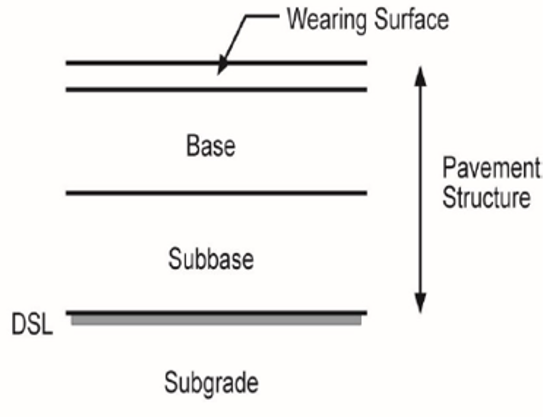
Figure 1: Unbound granular pavement with thin bituminous surfacing (from Austroads)
The VAGO audit [1] notes that state roads carry most of Victoria’s traffic and freight vehicles, and 82% of state roads are in regional Victoria. So, the archetype of most interest is a regional unbound granular pavement subject to heavy traffic.
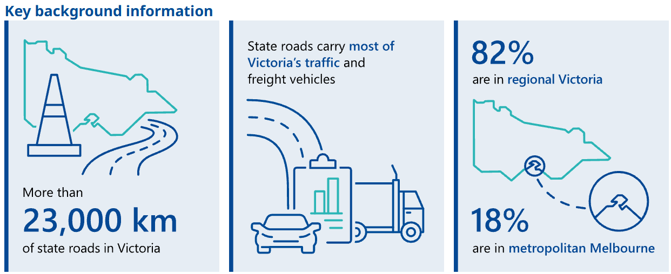
Figure 2: Victorian State Roads (Source: VAGO)
Austroads Pavement Analysis Design Software AustPADS allows users to conduct advanced mechanistic analysis of the response-to-load of road pavements. The AustPADS Introduction Video shows a worked design example of an unbound granular pavement with thin bituminous surfacing (Example starts @37mins).
Figure 3: AustPADS Design Example – Unbound granular pavement with thin bituminous surfacings
The AustPADS example models a pavement of 475mm crushed rock on a CBR5 subgrade. This design will be adopted as the baseline, being conceptually representative of a typical regional Victorian state road pavement.
The analysis will consider a scenario where the baseline pavement has reached end-of-life and rehabilitation is required. Three rehabilitation options will be considered:
- Reinstate original design (aka Unbound granular)
- 150mm stabilised sub-base with 150mm granular overlay (aka Upside-down)
- 300mm Renolith-enhanced stabilised base, no overlay (aka Nanoengineered)
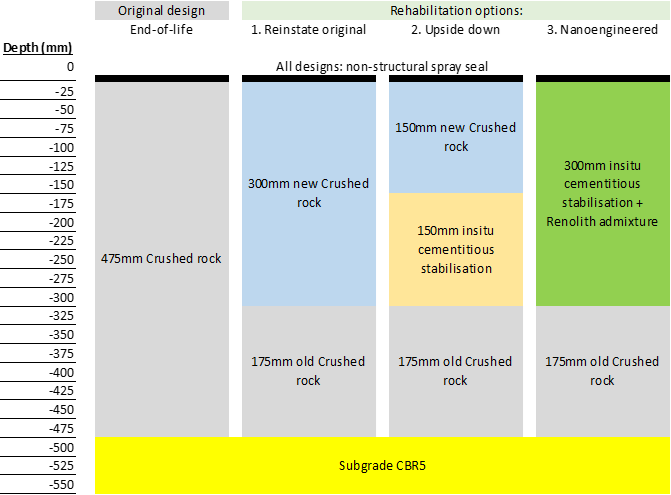
Figure 4: Rehabilitation Options – Pavement structure
The design options are assessed subject to the following assumptions and simplifications:
- Non-structural spray seals will be reinstated for all designs
- Surface levels do not change (eg. align with extant kerb & channel if relevant).
- Only the top 300mm of the pavement is degraded to the point where rehabilitation is required.
- Per the AustPADS tutorial, the design loading adopts a Standard Axle Design and the ratio of Equivalent Standard Axles (ESA) to Heavy Vehicle Axle Groups (HVAG) = 0.7.
- Granular material is ‘normal standard crushed rock’, with presumptive values per Austroads AGPT02 [3] section 6.2.3.
- Cemented layers are institu materials (degraded crushed rock) bound with ~3% cementitious binder.
Excluding wearing course, the materials footprint of each option is shown below.
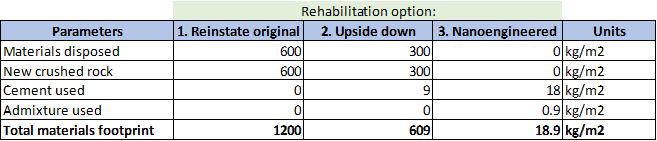
Figure 5: Rehabilitation Options Comparison – Materials Footprint
Option 1: Reinstate original design
This design requires 300mm of degraded material to be dug out and replaced with new crushed rock.
The maximum vertical modulus is 350MPa per Austroads AGPT02 [3] table 6.3. The AustPADS sublayering function is used for calculating the moduli of sublayers.
The pavement life calculated by AustPADS is 5.95e6 ESA.
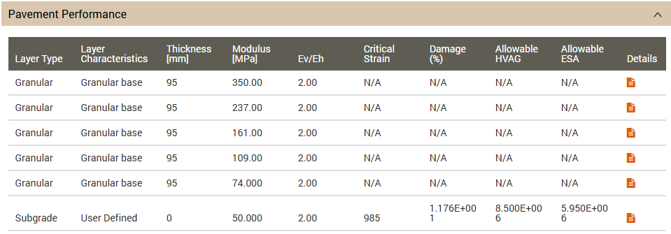
Figure 6: Rehabilitation Option 1 – Reinstate original design – AustPADS Outputs
Option 2: Upside down pavement
This design requires 150mm of degraded material to be dug out, then 150mm of insitu material is stabilised with cement. The cemented layer is topped with an overlay of 150mm new crushed rock to bridge reflective cracking.
Presumptive moduli are adopted for each layer per Austroads AGPT02-25 [3] as follows:
- 150mm granular overlay: 350MPa per table 6.3.
- 150mm cemented: 3000MPa per table 6.7
- 175mm residual granular: 150MPa per table 6.4
The pavement life calculated by AustPADS is 3.25e8 ESA.
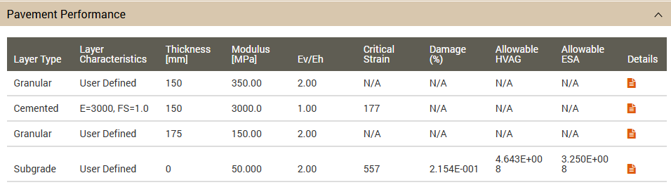
Figure 7: Rehabilitation Option 2 – Upside down pavement – AustPADS Outputs
Although common in Victoria, “upside down pavements” are not universally accepted because moisture can get trapped in the unbound base layer. This can exacerbate the risk of water-related defects such as potholes. For example, TfNSW TS 10801 Supplement to Austroads Guide to Pavement Technology, Part 5: Pavement Evaluation and Treatment Design [4] states:
7.5.3 Granular Overlay
Avoid placing a granular pavement over a bound layer which forms part of the pavement. The granular material may be intended to bridge reflective cracking from the bound layer but results in an “upside down pavement”. An upside down pavement is considered to be a high risk treatment in moderate to wet climates…
Option 3: Nanoengineered
This design stabilises 300mm of insitu material with cementitious binder and ‘Renolith 2.0’ admixture.
‘Renolith 2.0’ is an admixture of nanomaterials and polymers in water. In the context of this design, it is presumed to enhance the cemented material as follows:
- Renolith prevents macro shrinkage cracking, hence there is no need for a granular overlay to bridge reflective cracking. The spray seal wearing course is applied directly over the bound base layer.
- Renolith reduces permeability and increases soaked strength, hence the base layer is highly resilient to water-related damage. So, potholes are very unlikely even if spray seal maintenance is neglected or the road is flood-affected.
- Renolith increases strength and moduli. For modelling, it is conservatively assumed that a 20% gain in Flexural Strength and Elastic Modulus is achieved compared to the otherwise identical Option 2 cemented material.
- Renolith lubricates the working mix, improving compaction efficiency. Full compaction to 300mm is achievable.
The pavement life calculated by AustPADS is 5.14e10 ESA.
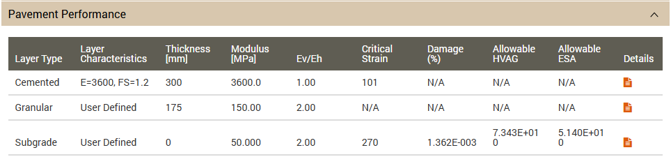
Figure 8: Rehabilitation Option 3 – Nanoengineered base – AustPADS Outputs
Austroads AGPT02-25 [3] section 2.2.3 notes:
The use of heavily bound cemented bases with sprayed seal surfacings is more commonly associated with the rehabilitation treatments of granular pavements than new construction works. With the exception of temporary pavements, this pavement type is seldom used for new works due to significant performance issues associated with shrinkage cracking…
Renolith admixture is highly effective at preventing cracking problems in cemented materials. See https://renolith.com.au/crack-free-roads/ for more information, excerpt below:
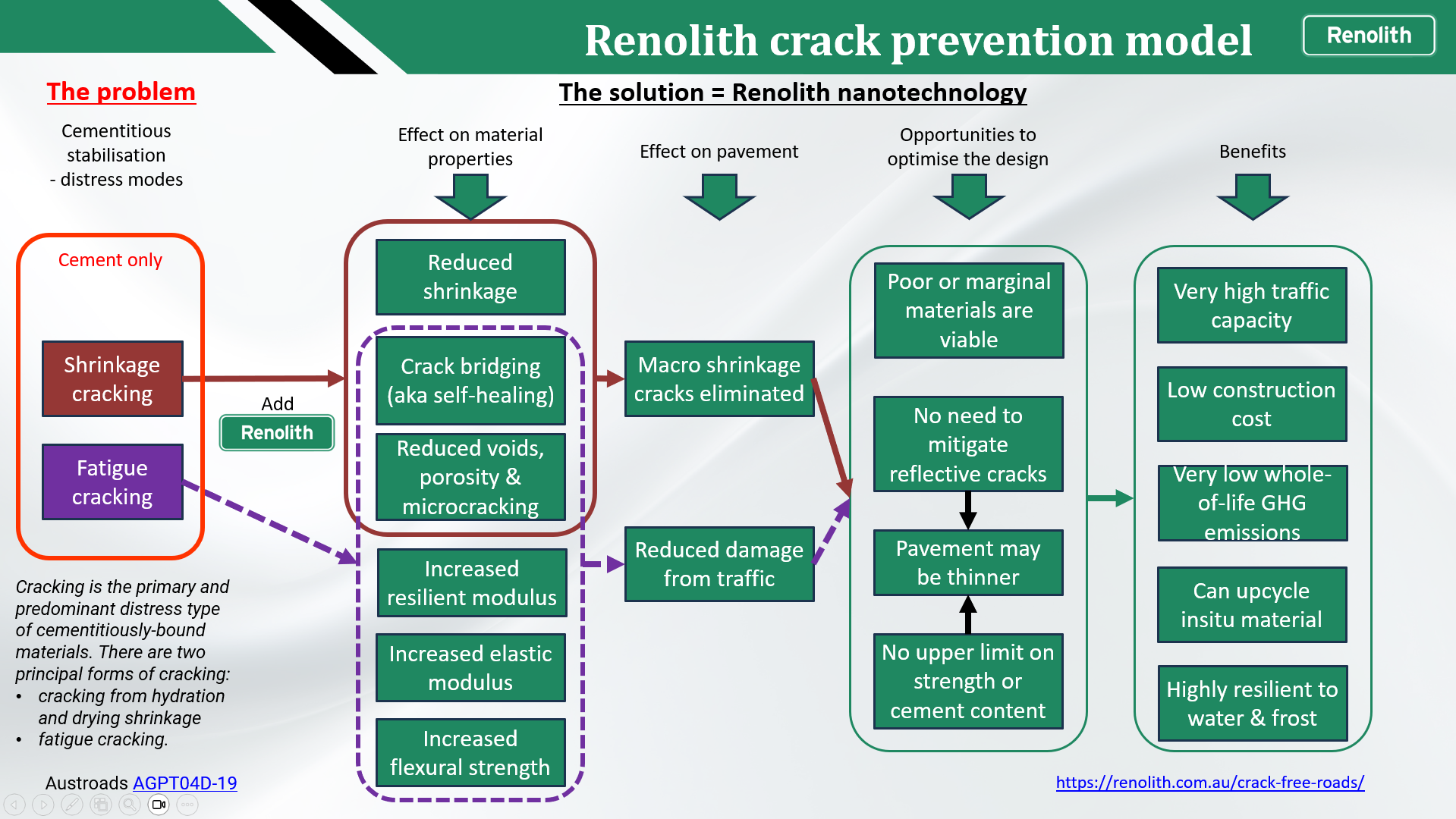
Figure 9: Renolith Crack Prevention Model
Comparison
The table below shows a comparison of the three rehabilitation options.
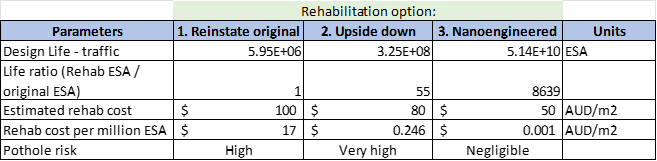
Figure 10: Rehabilitation Options Comparison – Life, Cost and Pothole Risk
It can be seen that:
- Reinstating the original unbound granular design (Rehabilitation option 1) is the most expensive and yields the shortest life (traffic capacity). Pothole risks remain high.
- Conventional stabilisation with granular overlay (option 2) yields a higher theoretical design life than reinstating the original design (option 1). However, the risk of potholes is increased. The Victorian road network already generates over 250,000 potholes per annum. Potholes are a serious safety issue. Risks are exacerbated by extreme wet weather and underinvestment in maintenance interventions like resealing – risks which have materialised in Victoria.
- The nanoengineered pavement (option 3) significantly outperforms the alternates on every measure. Rehabilitation costs are lower. The risk of potholes is negligible. Pavement life is radically increased. Value for money is superior.
Conclusion
Victoria’s state roads are deteriorating. Roughly 37% of the state’s 23,000km road network is in very poor condition. A substantial proportion of the network requires rehabilitation now or imminently.
Conventional rehabilitation design archetypes will not solve the problem. Cementitious stabilisation enhanced by Renolith 2.0 admixture radically reduces both lifecycle costs and the risk of potholes. This rehabilitation model has excellent potential to reverse the decline of Victoria’s roads, offering a shovel-ready solution to Victoria’s pothole crisis.
Bibliography
|
[1] |
Victorian Auditor-General´s Office, “Maintaining State Roads | Victorian Auditor-General´s Report 2026–27,” Melbourne, 2026. |
|
[2] |
Austroads AGPT04-25, “AGPT04-25, Guide to Pavement Technology Part 4: Pavement Materials, Ed2.0,” Austroads Ltd, Sydney NSW, 2025. |
|
[3] |
Austroads AGPT02-25, “AGPT02-24, Guide to Pavement Technology Part 2: Pavement Structural Design, Ed5.0,” Austroads, Sydney, 2025. |
|
[4] |
TfNSW, “TS 10801 Supplement to Austroads Guide to Pavement Technology, Part 5: Pavement Evaluation and Treatment Design,” Sydney, 2021. |